Showing posts with label vegan. Show all posts

Friday, May 31, 2019

pretty-colored potato rolls -- again.

We're almost at summer! So summer-colored bread buns. Also, potato hotdog buns (which, to be fair, are also great made into lobster rolls -- just split through the top rather than the side)... Partly inspired by the purple burger buns at Hapa, and my previous colored potato braid. Potato rolls are a classic for sandwiches because potato has a sort of timed-release moisture action in the baked bun, keeping it moist and soft but sturdy enough to stand up to loading with filling. These are not quite as smooth as Martin's, but they are tasty and a bit more complex in flavor because of the sourdough.  

The potatoes -- purple and Yukon gold, microwaved (most microwaves have a potato setting! If yours doesn't, one large or two smaller potatoes will take about 3 1/2 to 4 minutes on high), cooled, peeled and mashed. These are purple regular potatoes, not Okinawan sweet potatoes or Filipino ube. They're really deep purple!


Sourdough Potato Hotdog Buns (two-color version) makes 16 hotdog buns or 10 120 g burger buns
sponge: 
100 g. bread flour
90 g. water
20 g honey
8 g active dry or instant yeast
Beat together in the mixer bowl and let rise 1-4 hours, until puffed and bubbly. (if you're using instant yeast, you may want to add half now and the other half with the starter.)

Add and mix in with the hook:
320 g starter, fed 6-10 hours before
180 g bread flour
8 g salt 
20 g dry milk powder (optional)
(let rest 15-20 minutes to autolyse, if you wish. It's not essential, but it makes a smoother, more consistent dough.) Mix the dough again and divide it in half. 

175 g each mashed purple and Yukon gold potatoes (or 350 g of one kind)
30 g butter (or margarine, or coconut oil)

(Of course if you just want one color you'll skip the dividing and just mix the potatoes in with the whole batch.)
Add the potato to each half and mix it in with the butter (15 g or 1 tbsp for each part.) It might take a bit of kneading on the counter to get a uniform color, (I'm kind of disappointed the yellow is not that vibrant), round, then place in lightly buttered bowls and let rise until doubled, about 40 minutes to an hour.


Smileyfaces in the risen dough!

 Fold the edges in to de-gas, then turn each out.

Divide each into pieces about 38 g each, and fold to pre-shape. (The two in the middle will be single-color, so they're 75 g each.)


Roll into 6-inch ropes and twist. 

Lay them on a nonstick mat or parchment,
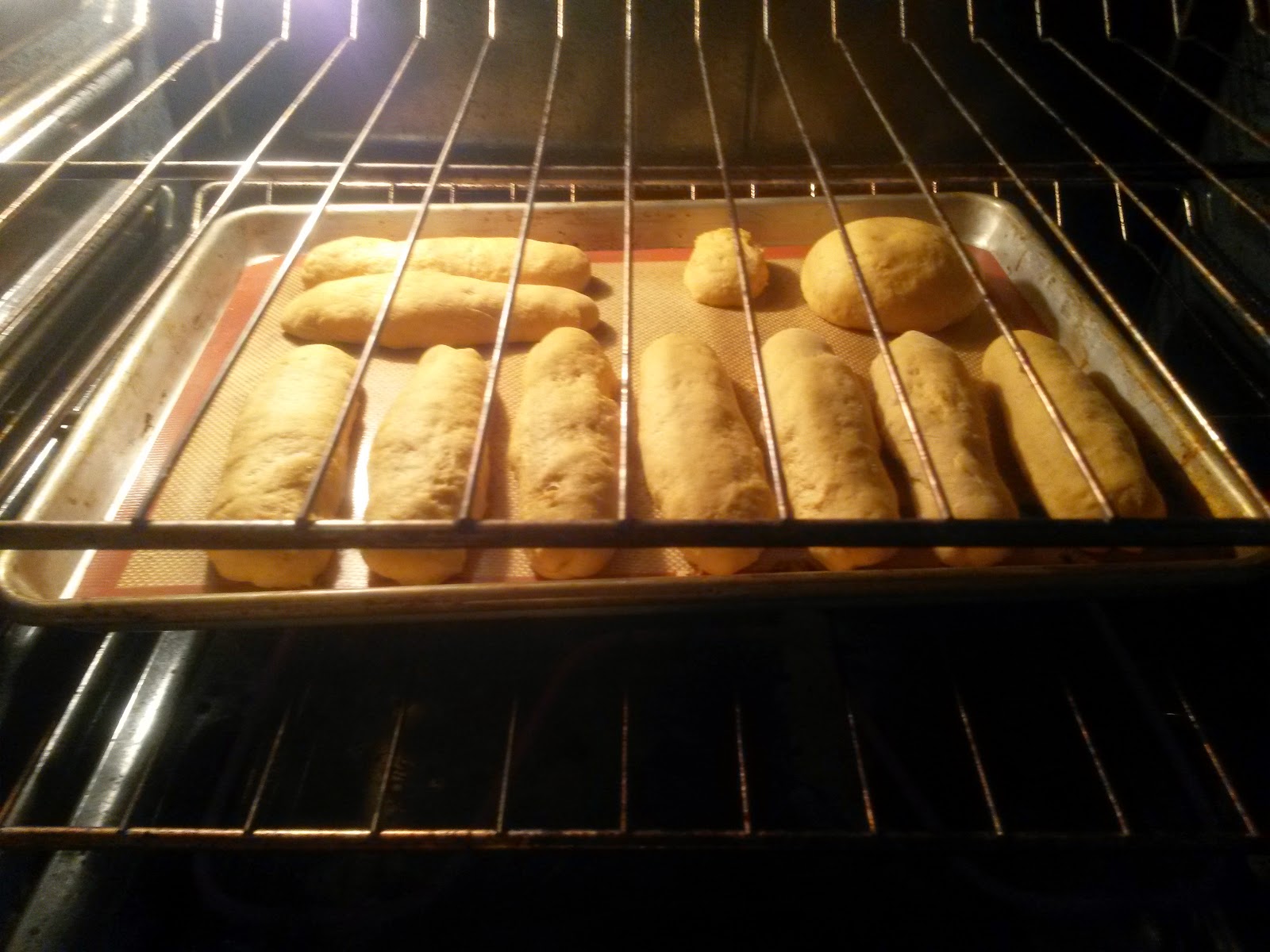
cover with a lid or plastic, and let rise... they may touch, but that's okay.
 

Bake at 350 about 20 minutes, until browned and sound hollow when tapped (the crust will be firm, but it softens as it cools). Pull them off the sheet and allow to cool on a rack so the bottoms don't get soggy.


The interior crumb.

Enjoy! 


Thursday, March 28, 2019

Sourdough starter -- starter pack! And pizza dough.

Crap I'm embarrassed. I've been saying that you can find a lot of info about sourdough starter on my blog, but there's no actual starter-sitting/maintenance info!! I swear I did a massive post several years ago, but suffice to say that I don't know where it went. Did I post it on another blog? Facebook or tumblr maybe? who knows.

So forthwith, a getting-there-without-tears sourdough starter post. The French call it a levain, and it's a batch of happy yeast cells in a liquid medium that is used by itself or in combo with commercial yeast to make doughs rise. 


There are many tutorials out there about how to begin a sourdough starter from scratch, such as Rose Levy Beranbaum's Bread Bible (she makes a stiff starter, double the flour to water, but the principle is the same) and the King Arthur Flour blog, and several videos as well. (I started mine about 20 years ago from organic rye flour, organic grapes and bottled water.)

If I've given you some of mine, or someone else has, then you just have to feed the starter and it will live on indefinitely. Every time you use it, just feed the remainder and the cells will remain active and the starter is ready to use whenever. If you don't plan on using it more than once a week, the starter can live in your fridge, where the cell activity will slow down from the cold enough so it stays alive, but not exhausting its food supply.


To feed the starter, weigh what you have and feed it half its weight in flour and half in water. For example, if the starter weighs 150 grams, you will stir in 75 g. flour and 75 g. water. You will then have 300 g. of starter, that will be most active if you give it about 6 hours at room temperature. It should rise to about double its size in about 4 hours. If you don't plan on using it soon, leave the fed starter at room temperature for an hour, then refrigerate it.


If you don't plan on using 300 g. and you want to keep less, you can discard some before you feed it, as long as you keep at least 60 g., to be fed 30 g each of flour and water. This amount fits in a pint container or 12-ounce jar with room to rise.


When you do want to use the refrigerated starter, leave it out at room temperature for an hour or two and watch for it to rise slightly. Then use however much your recipe calls for. Weigh the remainder and feed it as before, half water and half flour by weight. 


If you won't be using your starter for a bit, it will be okay in the freezer -- the longest I have frozen mine was two weeks. When you want to maintain it again, leave the frozen starter out at room temperature until it thaws out completely. Feed it as above and leave until you see bubbles and it has that fruity, slightly beer-y smell -- it may not rise to fully double, but it will be fine.

If you forget to feed your starter in the fridge for a week or two, and there is clear or greyish liquid on top, it is still okay. Stir that liquid back in, discard half of the starter, and feed it. Leave it at room temperature until it rises, then either use or refrigerate. If it takes a long time to rise (more than 6 hours with no activity), feed it again. Usually the most neglected starter will bounce back after two or three feedings 12 hours or so apart.

⇒⇒⇒If you ever see pinkish or orangey spots or liquid, or black mold, do not hesitate to throw the starter out. This is a sign of potentially harmful bacteria. Contact me to give you some more 😁, don't feel that you have to save it.

Here as an act of good starter faith is the pizza dough recipe I use: (even though at the moment my home oven is not conducive to pizza-making -- i will live through you all.)


Sourdough Pizza Dough
220 g. room-temp water
10 g. (2 tsp.) active dry yeast
165 g. all-purpose flour
300 g. bread flour
15 g. (1 tbsp) salt
15 g. (1 tbsp) sugar (optional -- it makes it brown better and rise a bit faster)
200 g. sourdough starter, fed about 6-10 hours before 
50 g. olive oil

Dissolve the yeast in the water. Mix together the dry ingredients. Form a well, and add the wet ingredients and yeast water. Combine with your fingers, sweeping the flour into the well to form a shaggy dough. Knead it until it is smooth and elastic, and you get a gluten window. (in the mixer, go 3 minutes on low, then 6-8 minutes on medium). Turn the dough out of the bowl and knead a few times just to bring any wet parts and dry parts together. Put a little olive oil in the bowl and drop the dough back in, turning it over to coat. Cover with plastic wrap.
Let the dough rise til it doubles (about 40 minutes) then knock it down and divide into pieces -- I usually make two 14" or three 10-12" from this size batch, or about 240 g. each for 4 individual pizzas depending on how thin you want to stretch it. 
Shape each piece into a ball, return them to the oiled bowl, cover, then rest in the fridge til you're ready to stretch. (Or freeze on an oiled pan until solid, then place in a freezer bag.)
I prep all my toppings first, then stretch and top and right into the 475 oven. If you want it puffier/more foccacia-like, let the pizza rise about 10-15 minutes with the toppings on.   

Rise, and shine! 

Monday, February 4, 2019

A Banananana loaf/muffin to make basically anytime.

I hoard bananas in my freezer. Gone now are the days when I needed them as an egg substitute, but I still feel wasteful if they get to that perfect mottled ripeness and don't get eaten, so in the freezer they go. While in the summer they make a great smoothie, in the winter you need something less chilly. Before I know it I have a stash enough to make several loaves of banana bread, which is delicious and always consumed quickly. Yes, I always end up making more than one loaf because I feel wasteful (again) of the oven space. Or less often I make muffins. Either form is quick and very easily adapted-- add nuts, chocolate, coconut, even sub gluten-free flour. Everything else is probably already in your pantry -- which is part of why this recipe comes together so easily; there are no eggs or dairy to worry about picking up from the store.

Easiest Banana Loaves or Muffins
Makes 2 8 1/2 x 4 loaves or about 20 regular-sized muffins -- coat pans lightly with cooking spray or line with paper.

Dry ingredients: Whisk until combined:
I usually do 1 1/2 cups (180 g) whole wheat flour and 2 cups (240 g) regular all-purpose flour because I like the taste, and the fiber/nutrition boost. 
1 1/3 cups (235 g) sugar -- again, you can do part brown sugar or all muscovado or coconut sugar.
2 tsp. baking powder
1 1/2 tsp. baking soda
1 tsp. salt


Wet ingredients: 2/3 cup (160 ml) oil -- coconut, corn, etc.
2 1/2 cups bananas (if previously frozen, they pretty much peel themselves thawed)
 Vanilla extract, lemon/lime/orange zest or extract, nuts, chips, etc. can go in too.

If you use a mixer, put the wet ingredients in first and mix on low until the bananas are smooth. Add the dry ingredients and mix just until combined. If the bananas were very ripe, you should have a batter that holds a trail when a spatula is run through:


If it is too stiff, adjust the thickness with coconut or regular milk, or water.
 Divide evenly between the pans. It will come about halfway up or a little more.


Bake loaves at 350 about 40 minutes, turning halfway through time. They are done when a skewer or toothpick comes out clean from the middle, or with a few moist crumbs. Muffins will take about 12-15 minutes, depending on size.

Store covered at room temperature -- the loaves go quickly if you leave a table knife handy. Muffins freeze well in a zip-close bag, to be thawed individually for a portable breakfast. (spread with Nutella, they are gone even faster. But not at our [still nut-allergic] house.)

Tuesday, March 13, 2018

sourdough potato bread color experiments...

Fun with spuds! This idea had been playing around in my head for awhile, and when there were some beautiful purple fingerlings in a mixed bag I knew it was a sign that this 3-color potato bread needed making, in time to tweak a bit before Easter.
I started with the same potato/sweet potato bread used to make the hotdog buns -- by now a mere cousin of RLB's Bread Bible and blog version. I doubled the potato and used high-gluten flour in the main dough to compensate, and added some liquid starter for flavor and ease of shaping. (I don't use the milk powder or butter for allergy reasons.)

This makes one showy loaf  about 14 inches long but relatively flat, as braids go. (If you want a deeper/taller slice, you could rise and bake this in a pan, or make the ropes shorter and fatter.)
First the potatoes: boiled a regular (white) potato and the purple Vilotte (i think, they weren't labelled) fingerlings until tender, then drained and mashed. The sweet potato i cooked like i normally do: in the microwave, then mashed. I ended up with about 70-80 g of each.
Cooked and mashed potato varieties. They are in matchy bowls because i can. :D
 The sponge is mixed as normal and risen, using the potato cooking water. I then completed the dough as one, then divided it in three parts to knead in the colors of potatoes, but you might find it easier to divide the sponge into three bowls and add the other ingredients to form separate colored doughs.
The completed doughs -- kneading in the potato and oil or vegan butter. It's unintentionally a big smiley.
Shape each into a ball  then let rise covered until doubled. I put them right on a nonstick mat.
Before the first rise, and after the second.
Punch down and envelope fold, then rise another time; it should take about 45 minutes each time.
To shape, press one round into an oval, then roll up and pinch the seam so you have a tube with pointed ends, like a football... press out any big gas bubbles as you roll. Elongate the rope slightly, but keep the middle a bit thicker and the ends pointed. Do the same with the other two colors, lay them side by side, and start braiding from the middle.
Press the ends together and tuck them in. Flip the pan and braid the other end the opposite way, keeping the tension even... this keeps the shape consistent.
Cover (I use another pan to make sure there won't be sticking) and let the braid rise until it about doubles, about another 40 minutes. It should feel puffy, almost wobbly, when pressed with a fingertip.
Bake at 375 about 30 minutes. (I don't like eggwashing savory breads that don't have egg in them, especially ones that color well on their own, but you do you!)  It's done if you hear a hollow sound when tapping lightly underneath. 
Nicely colored! As you can see the white and purple strands broke a little as they rose and oven-sprang... 
The braid will have a crunchy crust when it comes out, but that will soften as it cools and the moisture distributes evenly.
My braid looked fine when it went into the oven, but as it rose and baked, the regular and purple ropes kind of fell out compared to the orange. It might be because of extra moisture from boiling, so next time I'll cook all the potato types by the same method and give up having cooking liquid in favor of ropes that keep their shape. (Of course, there will be an update when I accomplish that!)

Let the braid cool to the touch before you slice... even with the potato, it's a delicate crumb that will crush and gum up if it's too hot. But look how pretty! 


Tuesday, February 17, 2015

hotdog buns 2.0!

I seem to pick long holiday weekends to do my potato bun testing... this will be a short post, because it's just a tweak of the original. But I do have pictures!


Sourdough sweet potato hotdog buns that are vegan (dairy and egg-free), soft and have a bit of a protein boost. I incorporated some tweaks from last time: besan flour, which is ground-up beans, has 7 grams of protein per ounce, and a nice pale gold color; sweet potatoes, which aside from giving the dough color, provide a bit more moisture and sweetness; freshly-fed active sourdough starter and reduced amount of yeast; and white whole wheat flour and high-gluten flour.
The tweaked proportions:
Make Sponge: Mix together in a mixer bowl:

150 g. cooking water, 10 g. dry yeast, 100 g. besan flour, 100 g. white whole wheat flour.
Let sit at least an hour. Add:

300 g. high-gluten flour
100 g. white whole wheat flour
Mix just until incorporated, then let rest 20 minutes. Add:

365 g. active starter (6 hours after feeding)
365 g. mashed boiled sweet potato (two medium-sized potatoes)
60 g. kosher margarine
15 g. salt
50 g. dark brown sugar
Switch to the dough hook and mix 10 minutes on low speed. At first it will look too wet, but as the moisture distributes and the gluten develops, the dough will come together round the hook and clean itself off the bowl. If it doesn't after about 5 minutes, add a handful more of either white or whole wheat flour.
Once it's smooth and silky and passes the windowpane test, round it out and cooking spray the top or brush with margarine. Cover and let rise 2 hours, turn out and give two 3-folds, then let rise another 2 hours (or what I did: ferment 1 hour, 2 3-folds, then overnight in the fridge.)

We made mostly hot dog buns, 75 g. each, but also two burger buns (4 ounces/ 113 g. each) and two soft pretzels.

Let them rise, covered with a towel... 

it only took about 30 minutes -- they should just touch....


and into the oven. 

Bake at 360 until nicely golden.

Look how yummy and golden!!!

Nice and soft, but substantial enough to hold up against juicy burgers and condiments. The buns, minus two which we just had to sample, get to live in the freezer for hot lunches... yum!


Wednesday, March 12, 2014

Cinnamon Raisin Bread, with whole wheat and sourdough.


What have we here? (Mother's on the scale)
Ingredients for the preferment: part of the flour, milk, part of the yeast, raw sugar.

Whisked well together... not too liquid but smooth.

In goes Mother, whisk that in well.

Measuring out the rest of the ingredients for the "blanket": the remaining flour, salt, sugar, the remaining yeast.

Pour it on top but don't mix in. Cover and let it rise (meanwhile, go to the store for raisins and stuff to make a salad lunch) 

All risen! see how it's poked up through the blanket. Stir the blanket in with a spatula.

Add the rest of the ingredients: raisins, cinnamon and coconut oil. Mix with the hook until it's picked itself up off the sides and makes a satisfactory slap-slap sound. 

Knead a bit on the counter if you like, until it's nice and smooth. Put a bit more oil into the mixer bowl.

Drop the dough back in, cover and let it rise.

Oooooh, it's gotten big! See how much nearer it is to the rim of the bowl.

Knock it down, then divide in two equal pieces.

 Make a rectangle as wide as the pan and about twice as long.

Roll down a third, pinching at the fold.

Roll up to the end, pinching the seam closed.

Push the side of your hand in at an angle, making flaps.

Pinch up and seal the flaps -- this makes a nice firm short end that is not too skimpy for sandwiches.

Put each into the oiled pans. It should touch the short ends but don't worry if it doesn't touch the long sides. Let them rise until they come up above the pan side. When they are level with the top, start to preheat the oven.

Ready to bake!

The final product -- how yummy! Between the three of us we finished half a loaf while it was still warm.

Cinnamon Raisin Bread!! I decided to rope K into making some replenishments for her lunchbox. While I'm reconciled to making croissants, I was pleasantly surprised to have her agree to cinnamon raisin bread, that was safe for P as well.
Jumping-off point was The Bread Bible, with a few changes: soy milk, or whatever milk they drink, and coconut oil instead of the dairy originals; raw sugar instead of honey; a starring role for Mother, my sourdough; a little whole wheat, and more raisins.
As pretty as swirl bread is, I really don't like when there is a huge gap in the slice -- known as shelling. So instead of sprinkling on the raisins and cinnamon when rolling up, we added them directly to the dough.
Nom nom nom.